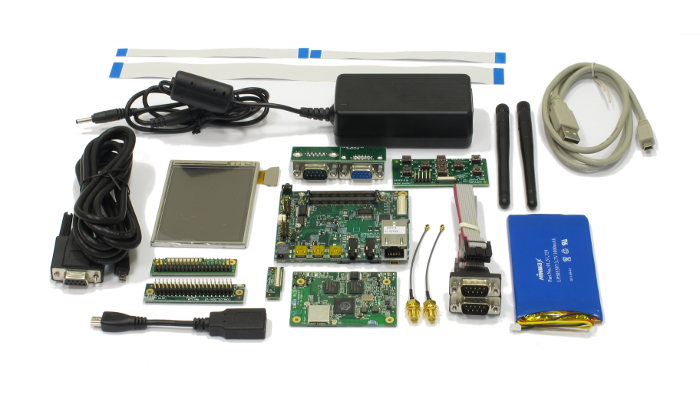
CM-X300 Computer-On-Module
- Entry-level ARM platform for embedded applications.
- Low cost and flexible system provide an ideal solution for cost-sensitive designs.
- Low power and battery support enable mobile and handheld applications.
-
Product Highlights
- XScale PXA300 / PXA310 CPU, up to 624 MHz, 32+32 KB cache, WMMX2
- 64 - 128 Mbyte mobile DDR
- 512 Mbyte Flash Disk, including filesystem protection
- WLAN / WiFi 802.11b/g Interface
- Bluetooth interface
- Graphics controller supporting STN and TFT panels with 800 x 600 max resolution
- H/W support for H.264, MPEG-4, H.263, MPEG-2, RealVideo, WMV9 and other video codecs.
- General purpose bus
- AC97, SDIO / MMC interfaces
- Camera Interface port
- Sound codec with speaker and microphone support
- Touchscreen Controller
- USB Slave / Host / OTG ports
- Serial ports, GPIO
- 100 Mbps Ethernet port
- Very low standby and active power consumption
- Battery charger and management support
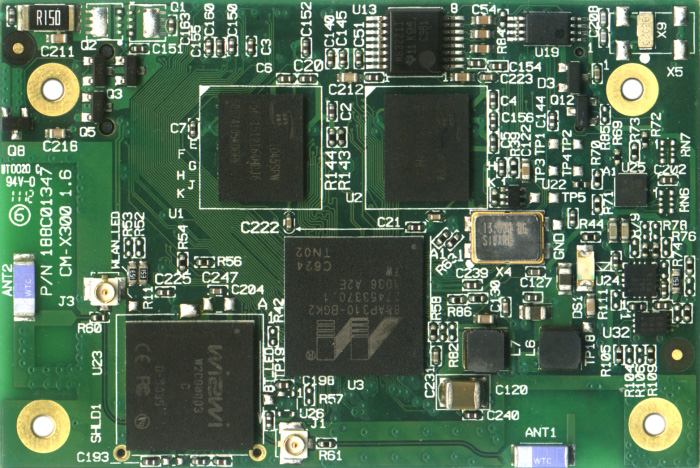
- Small size: 66 x 44 x 7 mm
- SB-X300 carrier board turns the CM-X300 module into SBC-X300 - a single board computer
Description
The CM-X300 is a small Computer-on-Module board designed to serve as a building block in embedded applications. The CM-X300 has all the components required to run operating systems such as Linux and Windows CE. Ready packages for these operating systems are available from CompuLab.
The small size and low power consumption of the CM-X300 allows its integration into hand-held and mobile devices, while its low price makes it an ideal selection for cost-sensitive applications. The CM-X300 delivers a price / performance ratio significantly better than that of any other platform.
The feature set of the CM-X300 module combines a 32-bit CPU, DDR, Flash Disk and vital computing peripherals. For embedded applications, the CM-X300 provides a general purpose local bus, 100Mbit Ethernet, serial ports, I/O lines and other essential functions.
Targeting the handheld application market as well, the module provides integrated WLAN (WiFi) and Bluetooth interfaces to implement industry standard wireless connectivity. Integrated battery charging and management enables easy integration in battery-powered mobile devices.
The standardized CAMI ("CompuLab's Aggregated Module Interface") connectors of the CM-X300 module allow interchangeability with other Computer-On-Module's available from CompuLab, enabling the flexibility required in a dynamic market where application requirements can change rapidly.
For feature support status, please refer to O/S Support Coverage Map. -
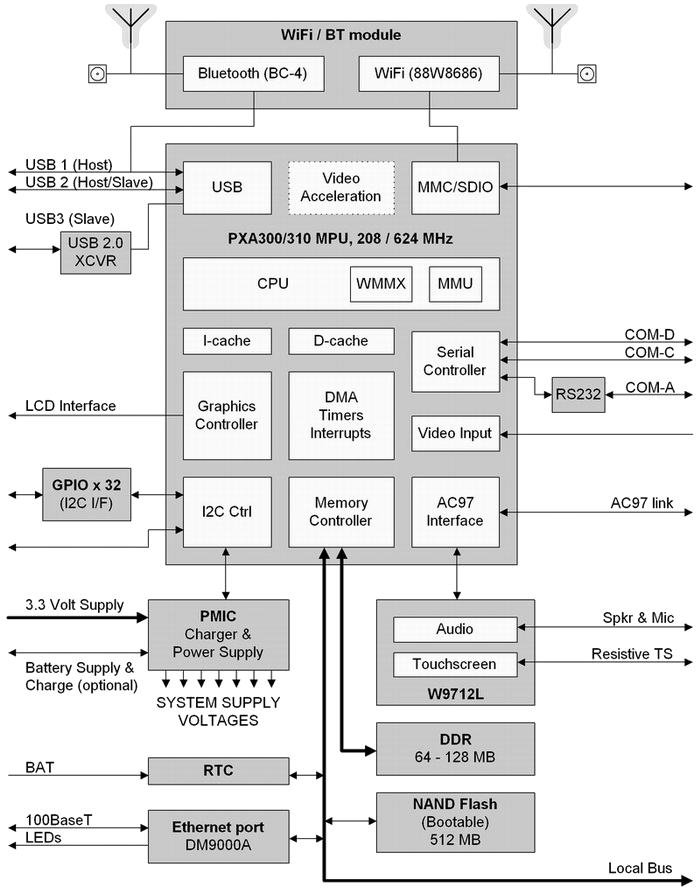
-
- "Option" column specifies the configuration code required to have the particular feature.
- "+" means that the feature is always available
CPU, Memory and Busses
Feature Specifications Option CPU Marvell XScale PXA300 / PXA310 / PXA320 CPU
208 / 624 MHz, WMMX2, 2*128K internal SRAM
32 KB I-cache and 32 KB D-cache, WB, 128 MB address space
DMA and Interrupt controllers, TimersC RAM 64 - 128 MB, DDR, 208 MHz, 16-bit D NAND Flash Disk 512 Mbytes, bootable. N External local bus 16-bit, variable rate up to 52 MHz, 3.3V tolerance + AC97 bus AC97 / AMC97 Rev 2.1 compliant + Peripherals
Feature Specifications Option Graphics Controller 8/16 bit color, TFT / STN, frame buffer in CPU SRAM or system DDR
Resolution: up to 800 x 480 x 16 without restrictions, and up to 1024 x 1024 with some restrictions about overlays, BPP and pixel clock.+ Camera Interface Direct camera sensor support, max resolution 2560 x 2048, pixel clock up to 52MHz. Available only with PXA310 CPU. C624M Hardware acceleration Supports up to D1 decode and encode performance for codecs including H.264, MPEG-4, H.263, MPEG-2, RealVideo and Microsoft WMV9.
Hardware scaling, rotation and other raster graphics operations.
* Implemented by PXA310 CPUC624M USB USB1: Full speed Host port. Shared with Bluetooth, therefore not available with "W" option WUSB2: In C624 - USB1.1 Full Speed host/device and OTG. In C624M - USB2.0 device + USB3: USB 2.0 Device port. Not available with "C624M" option C624MSerial Ports
(UARTs)Up to 3 UART ports, 16550 compatible, max 921 kbps
COM-A - RS232, Rx / Tx
COM-C - TTL, full modem controls (not available with C624M option)
COM-D - TTL, partial modem controls
+ C624M+ General Purpose I/O 42 dedicated lines (32 I2C-controlled + 10 memory-mapped) plus additional lines shared with other functions. Can also be used as interrupt inputs. + Keyboard & mouse USB, keypad or redirection from COM port + Ethernet Davicom DM9000A MAC & PHY, 10/100BaseT, Activity LED's E Audio codec Wolfson W9712L, AC97 interface, mono microphone input, stereo line input and 25 mW output for active speakers AT Touchscreen ctrl. A part of the W9712L codec chip. Supports resistive touch panels. AT RTC Real Time Clock, powered by external lithium battery R WiFi
InterfaceImplements 802.11b/g wireless connectivity standard
Supports Node to Access Point and Multi-Node (w/o access point) methods of connection. (but cannot act as Access Point)
Marvell 88W8686 802.11b/g chipset.
On-board ceramic chip antenna and connector for external antenna.W Bluetooth Bluetooth V2.0+EDR system. CSR BlueCore4-ROM chipset, 2.4GHz band, up to 3Mbps. On-board ceramic chip antenna and connector for external antenna.
Bluetooth and WiFi interfaces are always assembled together, and therefore are specified by the same assembling option.W Battery support 1. No battery support - operating voltage is 3.3V. Board is assembled with PMIC (power management IC) for specified operating voltage
2. Battery support - operating range is 3.4V to 4.5V. Board is assembled with PMIC dedicated for battery operation+
B Electrical, Mechanical and Environmental Specifications
Feature Specification Supply Voltage 3.3V from regulated power supply, or 3.4 to 4.5V from battery Active power consumption 0.2 - 2 W, depending on configuration and CPU speed Standby/Sleep consumption 20 - 100 mW, depending on configuration and mode Dimensions 66 x 44 x 7 mm Weight 25 gram MTTF > 200,000 hours Operation temperature (case) Commercial: 0° to 70° C
Extended: -20° to 70° C
Industrial: -40° to 85° C. Click for availability noteStorage temperature -40° to 85° C Relative humidity 10% to 90% (operation)
05% to 95% (storage)Shock 50G / 20 ms Vibration 20G / 0 - 600 Hz Connectors 2 x 140 pin, 0.6 mm Connector insertion / removal 50 cycles -
Hardware Documentation
Hardware Design Resources
Software Resources
U-Boot
Linux
Windows CE
Archive
For previous versions of the CM-X300 software packages, please refer to the CM-X300 software archive. -
CM-X300 and SBC-X300 Evaluation Kit
Package contents
Technical Support
- Technical support for 12 months.
- LCD panel compatibility verification and driver adaptation service.
- 45-day trial period. Eval Kit will be accepted for refund if the user finds the product not suitable for his needs.
Hardware
- CM-X300-D128-C624M-N512-E-AT
- SB-X300
- WiFi antenna and cable
- Serial port cable
- USB cable and adapter
- 3.5" 640 x 480 LCD panel with touchscreen
- Adapters & cables for generic LCD panel interface
- Keypad and cable
- 5V power supply
-
Product status: Mature
CompuLab part number specifies all options available for a particular product. P/N template: CM-X300-Dx-Cx-Nx-[E]-[AT]-[W]-[B]-[Tx]Minimal Configuration
Minimal configuration P/N: CM-X300-D64-C208-N128 1K-unit price $62.4
Optional Features
Feature Options P/N code Add ($) DRAM size 64 MB
128 MBD64
D128-
6CPU type & speed PXA300 / 208 MHz
PXA300 / 624 MHz
PXA310 / 624 MHzC208
C624
C624M-
2.4
12NAND flash size 128 MB
512 MBN128
N512-
20.4Ethernet No
Yes-
E-
7.2Audio & Touchscreen No
Yes-
AT-
3.6WiFi & Bluetooth interf.
(discontinued)No
Yes-
W-
22Battery support No - 3.3V op
Yes - 3.4..4.5V op-
B-
3.6Temperature range Commercial
Extended
Industrial-
TE
TI-
24
120Software Preloading No
Yes-
X-
$1/100MB- Prices are specified in U.S. Dollars. Prices are periodically updated according to variations in component costs. Prices are subject to change without advance notice.
Small Quantity Orders
Pricing is specified for 1000-unit orders. In order to calculate the price for another quantity, multiply the unit price (with selected options) by the factor listed in the table below:
QTY Factor 1K 1.0 500 1.2 100 1.5 10 2.0 1 2.5